But quilting on the marked line isn't our only goal. We want to memorize the movement so as the line goes to dashed and then disappears, we're able to continue the design consistently across the row of our quilt.
It's okay if your wave isn't quilted perfectly. Mine certainly wasn't.
And if you want to, you can stop here.
But I want to get the most bang for my buck, so I decided to continue quilting and fill up every inch of this first row.
Quilting Row 1 - Wave - Up a Notch
To the top of the wave, I stitched echoes. Echoing is a process of quilting a line parallel to your first line, or to any shape on your quilt.
To achieve the even spacing, you'll also need to travel quilt. This is a process of quilting right on top of a previous line of stitching.
Traveling and echoing are two major skills required for free motion quilting. Once you master these skills, you can pretty much quilt anything!
To the bottom half of the wave, I quilted more Wiggles. This provided more practice for echoing and space estimation.
Space estimation is the ability to quilt up to a spot, but NOT hit it. This is another major skill for free motion quilting and it's often tricky to build because our foot can block our view of the needle and exactly where we are in the quilt.
This is why I changed foot bases halfway through the video. While I love the ruler foot base for ruler quilting and 1/4-inch echoing, it is challenging to see and estimate space accurately.
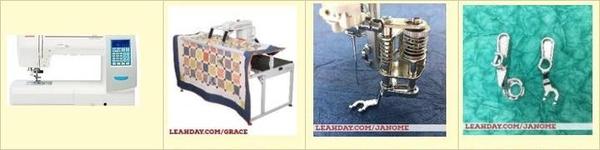
So I switched to the frame quilting open toe base. Click Here to find this Convertible Darning Foot which allows you to change bases and get the best view for free motion quilting!